Anesthesia Simulation
Learn. Practice. Reflect.
Simulation education
Build clinical skills, decision-making, and teamwork through a range of simulation experiences.
The Department of Anesthesiology at Cooper University Hospital is active in all levels of simulation education, from students to practicing providers and physicians. The Cooper Anesthesia Simulation Program is cutting edge and includes faculty and staff who have years of experience and expertise in this important area of medical education. The program is endorsed by the American Society of Anesthesiologists (ASA) and is one of a few elite programs chosen to be part of the ASA Simulation Education Network (SEN).
The Cooper Anesthesiology Simulation Program has established unique partnerships with physician educators throughout Cooper University Hospital and with community physicians and providers and has a faculty that is truly representative of the academic and private clinical sectors.
Our goal is to improve patient outcomes with effective programs that promote and enhance practitioner skills, clinical competence, teamwork, and interdisciplinary and interprofessional collaboration. To advance the field of healthcare simulation, the Cooper SimLab conducts innovative research into simulation theory, practice, and technology.
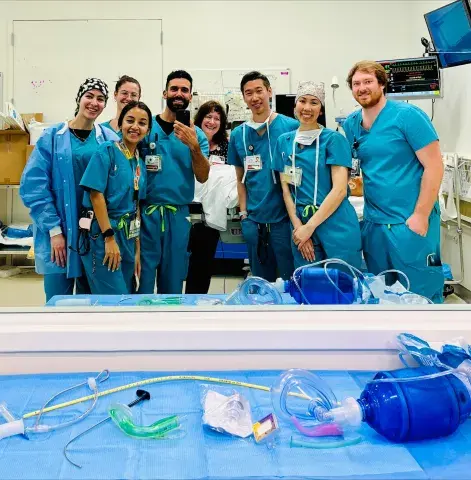


Residency Education
Simulation is integrated throughout the Cooper Anesthesiology residency curriculum with an emphasis on the acquisition and refinement of both medical/technical skills and behavioral/leadership skills. The Cooper Anesthesiology Simulation Division provides innovative educational programs that focus on critical events and team training. A key goal is teaching participants to prevent errors and to identify and recover from them in practice. The programs provide unique opportunities for practicing anesthesiologists and trainees to reliably acquire core decision-making, leadership, communication, and team skills.
- The simulation curriculum is adapted to the Cooper Anesthesiology residents’ level and experience. All objectives are tightly integrated with ACGME core competencies.
- Crisis Resource Management (CRM) is integrated throughout the curriculum.
- Simulation methods primarily use mannequin-based simulation along with reflective and formative debriefing.
- Scenarios vary from preoperative to intraoperative and postoperative, and represent cases that residents are likely to encounter in their careers.
- Senior Cooper Anesthesiology residents may take a one-month simulation elective and may become involved in research projects in the SimLab.
- Unusual and rare events are reviewed during simulation scenarios.
- Extensive preparation for the American Board of Anesthesiology (ABA) Oral Board Examination and for the ABA Objective Structured Clinical Examination (OSCE) is also covered in the simulation center through all years of the residency.
Continuing Medical Education, Maintenance of Certification in Anesthesiology (MOCA®) and recertification
As a leader in the field of simulation education, the Cooper University Hospital Simulation Laboratory is approved to provide the Maintenance of Certification in Anesthesiology (MOCA®) simulation course. This course offers immersive simulation education endorsed by the American Society of Anesthesiologists (ASA) for ABA Diplomates seeking to fulfill their Improving Medical Practice (Part 4) requirement for MOCA. The simulation course fulfills one requirement of the ABA MOCA Program. This simulation course is dedicated to advancing healthcare provider education and patient safety.
Please consult the ABA website (www.theaba.org) for a list of all MOCA requirements. MOCA and Maintenance of Certification in Anesthesiology Program are registered trademarks of The American Board of Anesthesiology, Inc.
MOCA Simulation Course Objectives
- Develop strategies to apply technical skills to appropriately diagnose and treat anesthesia emergencies.
- Develop strategies to apply crisis resource management skills during clinical crisis situations.
- Provide management of hemodynamic and respiratory critical events in anesthesia.
- Practice up-to-date techniques in a safe learning environment.
- Reflect on optimal teamwork, leadership, and communication skills required in crisis management.
- Develop strategies to apply reflective and self-assessment skills to the review and analysis of clinical performance.
Simulation Modalities
Cooper Anesthesiology Simulation uses a set of educational tools designed to:
- Imitate real patients, anatomic regions, or clinical tasks, or mirror real-life medical care situations
- Allow students to learn in a controlled, safe environment so they can “think through” a case or problem in a manner that is similar to reality
- Use devices, actors, and case reports
- Engage students in clinical scenarios
- Prepare residents for the OSCE component of the ABA Applied Examination
Simulation sessions are fully “immersive,” so participants experience a task or setting as they would in the real world. While it is a simulated environment, experience and research demonstrate that participants speak and act much as they do in the clinical environment.
Simulation may use various modalities – with or without different kinds of technologies – to replicate important aspects of the real world. The simulation modalities can be categorized in the following way:
- Standardized Patient Actors
- Partial-task Physical Trainers
- Virtual and Augmented Reality and Visualization
- Mannequin-based Simulation
Standardized Patient Actors
Often the best way to replicate a human being is with a human being. Specially trained actors are used to evoke many aspects of the real clinical world. These Standardized or Simulated Patients (SPs) are trained to portray patients with particular health conditions or concerns. They are able to give a consistent and predefined account of their condition and to answer a full spectrum of questions about themselves.
This allows anesthesiology residents to practice taking a medical history and carrying on a clinical conversation. SPs can be trained to portray different individuals from diverse cultures or who have particular communication challenges. SPs can help learners understand and practice difficult conversations, such as “end-of-life” discussions, discussions around adverse events, or the delivery of bad news. SPs can also undergo physical examination by the learner.
SPs allow physicians to learn how to handle complex or difficult patient encounters or to be assessed in doing so.
Part-task Physical Trainers
For many purposes, especially for learning particular skills, partial-task physical trainers can provide the key elements of the procedure. While they cannot fully replicate performing the task on real patients, they do allow learners to acquire initial basic skills prior to performing these procedures under supervision on patients.
Many kinds of part-task trainers are used by Cooper Anesthesiology residents. Hybrid programs that combine a partial-task physical trainer with a live standardized patient actor are also employed. For example, part-task trainers for suturing of deep cuts or lacerations consist of a pad of a special soft plastic material with a cut in the surface. Such a pad can be strapped on the arm of an SP and then draped with appropriate clinical draping material. The student not only has to perform the elements of closing the wound, but, as in real life, has to do so while conversing with the patient and attending to their needs.
Partial-task trainers are used at Cooper for central line insertion training, epidural placement, and ultrasound training.
Virtual and Augmented Reality
Virtual reality (VR) refers to a set of techniques in which the residents interact with a synthetic (“virtual”) environment that exists solely in the computer. In fully immersive environments or a “complete virtual reality simulation,” the participant is immersed in a virtual world that fully replicates at least three sensory inputs—vision, hearing, and touch (the last is more technically known as a haptic/kinesthetic system). This system allows complete physical interaction between the resident and the virtual world.
Ultrasound Simulation
We have a robust ultrasound simulation program where residents participate in sessions that focus on task training as well as realistic multidisciplinary scenarios. Our faculty are specifically trained to teach simulation.
We have a point-of-care ultrasound (POCUS) curriculum that takes advantage of simulation-based tools, as well as Butterfly ultrasound technology and ViMedix technology to teach POCUS and echocardiography exams. Faculty who are content experts in anatomical, regional, and cardiac ultrasound train residents in the simulation center, the ORs, and intensive care units.
Mannequin-based Patient Simulation
Mannequin-based patient simulation takes immersive simulation further and allows us to recreate a realistic physical clinical environment. The computerized mannequin stands in for the patient, and a variety of equipment can be used (either real clinical equipment or computer-driven replicas) to monitor and treat the simulated patient.
The mannequin-based simulator has a computer representation of the patient and allows for simulation of virtually all actual functions of patients. Among the functions that these mannequin-based simulators can replicate are:
- Spontaneous breathing (and the ability to breathe for the patient with a bag or ventilator)
- Real-time display of electronically monitored information (e.g., ECG, oxygen saturation, etc.)
- Pulses, heart sounds, breath sounds, pupil size, pupil response to light
- Obstruction of various parts of the airway
Not only are these created in their “normal” manifestation, but all the elements of a large variety of abnormal conditions can be created, such as myocardial infarction, severe allergic reaction/anaphylaxis, breathing difficulties, sepsis, malignant hyperthermia, severe abnormalities of glucose metabolism, etc.
Simulators are able to demonstrate the effects that many different drugs will have on patient physiology. Simulators also allow learners to insert tubes and needles as they would in a patient and to perform other interventions, such as defibrillation or applying an external pacemaker. Mannequin-based simulators contain speakers so that the mannequin can “speak” to the students, making the sessions more realistic.
Mannequin-based simulators are an essential element of anesthesiology resident education. They are able to simulate life-threatening situations that require prompt recognition and treatment by individuals or teams of clinicians so that residents can learn and treat these conditions in a safe environment. Residents are also able to learn about clinical work units and healthcare systems during simulations. Cooper Anesthesiology residents have used these lessons to pursue important and effective quality improvement projects at Cooper. These projects have had a meaningful impact in the workplace and led to beneficial changes in how we conduct medical education and take care of patients.
Cooper Anesthesiology Simulation Faculty
Drs. Burden, Ben-Jacob, Basch, Bolkus, Dal Nogare, Desai, Gandhi, Gratz, Hsu, Lee, Mele, Mitrev, Mulladzhanov, Naglee, Ocbo, Patel (A), Patel (K), Potestio, Pukenas, Rana, Sayed, Schenk, Schepel, Siri, Trivedi